
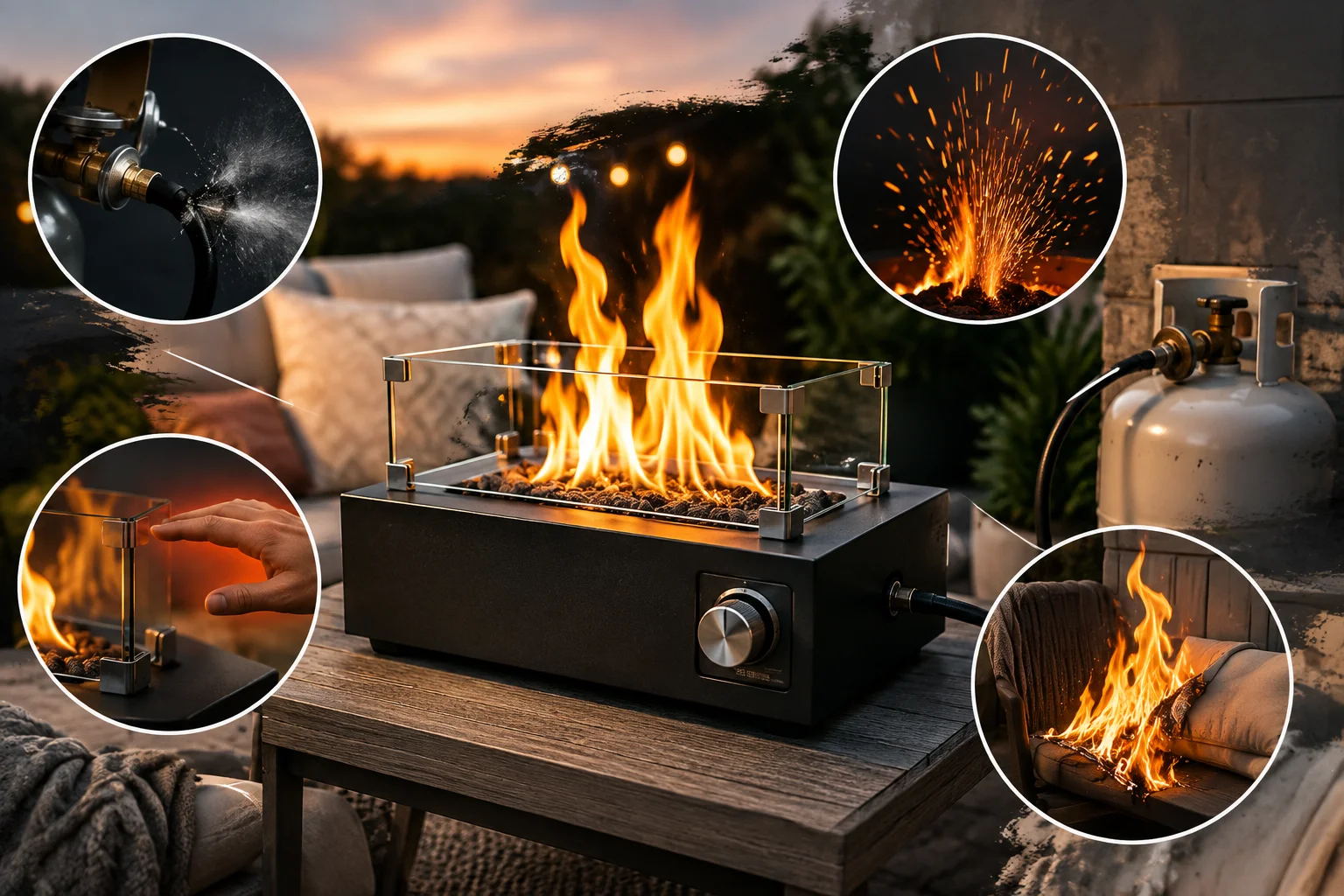

Fire-pit hazards vary substantially by fuel system. Propane products may present risks involving gas leaks, ignition, hot glass and metal, unstable cylinders, hose or connector problems, and nearby combustibles, while wood and pellet units can produce hot surfaces, sparks, embers, and secondary fires.
The CPSC alcohol-fire-pit warnings discussed below involve different fuel systems unless specifically stated otherwise. Anyone injured should preserve the Onlyfire product, fuel connection or remaining solid fuel, instructions, purchase records, photographs, and medical documentation.
Quick Facts
- ONLYFIRE OUTDOOR LIVING is specifically listed among tabletop fire pit brands in a nationwide attorney burn-injury investigation.
- Current Onlyfire tabletop products include propane models and separate wood-, charcoal-, or pellet-burning fire pits.
- Onlyfire’s 18-inch gas model uses an 11,000-BTU stainless-steel burner, tempered-glass wind guard, and lava rock.
- Potential claims may depend on fuel type, connectors, burner operation, stability, hot surfaces, warnings, injuries, and preserved evidence.
Table Of Contents
- Latest ONLYFIRE OUTDOOR LIVING Fire Pit Legal and Safety Developments
- What Is an ONLYFIRE OUTDOOR LIVING Fire Pit?
- Why Fuel Type Matters
- How Does the Onlyfire 18-Inch Gas Fire Pit Work?
- What Risks Are Associated With Propane Tabletop Fire Pits?
- Why Propane Connections May Matter
- Why Gas Leaks Can Be Dangerous
- Why the Glass Wind Guard May Matter
- Why Lava Rock and Burner Components Matter
- What About Onlyfire Wood and Pellet Fire Pits?
- How Can Sparks and Embers Cause Injuries or Property Damage?
- Why Hot Metal Can Present a Burn Hazard
- Why Stability and Table Placement Matter
- Why Outdoor Use Does Not Eliminate Fire Risks
- Other Tabletop Fire Pit Recalls and Warnings
- Why the Colsen Recall Is Different From Onlyfire
- What Injuries Can Fire Pit Accidents Cause?
- How May an ONLYFIRE OUTDOOR LIVING Fire Pit Accident Occur?
- Who May Be Affected?
- Who May Be Liable?
- What Is the Current ONLYFIRE OUTDOOR LIVING Fire Pit Lawsuit Status?
- Do I Qualify?
- What Evidence Should I Preserve?
- Why Model Identification Matters
- Do I Have an ONLYFIRE OUTDOOR LIVING Fire Pit Lawsuit?
- Important Legal Actions or Recalls
- Potential Compensation
- Legal Process Overview
- Frequently Asked Questions About ONLYFIRE OUTDOOR LIVING Fire Pits
- Do I Have an ONLYFIRE OUTDOOR LIVING Fire Pit Lawsuit?
- What Evidence May Support an ONLYFIRE OUTDOOR LIVING Fire Pit Lawsuit?
- What Fuel Does the Onlyfire 18-Inch Tabletop Fire Pit Use?
- Does Onlyfire Sell Wood-Burning Fire Pits?
- Are Onlyfire Fire Pits Alcohol-Burning Products?
- Can the Glass Wind Guard Become Hot?
- Have Other Tabletop Fire Pits Been Recalled?
- What Should I Do After an Onlyfire Fire Pit Accident?
- References
Latest ONLYFIRE OUTDOOR LIVING Fire Pit Legal and Safety Developments
July 2026
- July 16, 2026 – CPSC warned consumers to immediately stop using Houswise Tabletop Fire Pits because pooled or spilled alcohol can produce uncontrolled pool fires and refilling can cause flame jetting. CPSC reported more than two dozen incidents and seven injuries, including third-degree burns; the Houswise warning concerns a different open-liquid-fuel design and should not be treated as an ONLYFIRE OUTDOOR LIVING-specific finding [1]
May 2026
- May 2026 – Attorneys investigating tabletop fire pit burn injuries reported that they were actively reviewing individual claims nationwide and specifically listed ONLYFIRE OUTDOOR LIVING among the brands under investigation. The investigation does not establish that an Onlyfire product is defective or that a manufacturer, seller, or retailer is legally liable [2]
December 2024
- December 19, 2024 – CPSC warned consumers about certain alcohol or other liquid-burning fire pits that require fuel to be poured into an open container and ignited where it pools. CPSC reported two deaths and at least 60 injuries in that hazardous category since 2019; the warning does not establish that Onlyfire’s propane or solid-fuel products use the same design [3]
What Is an ONLYFIRE OUTDOOR LIVING Fire Pit?
ONLYFIRE OUTDOOR LIVING sells several compact fire-pit products intended for patios, balconies, camping trips, tailgating, beach gatherings, and other outdoor recreational settings.
One current product is the Onlyfire 18-inch Tabletop Gas Fire Pit, product number TOP2209-FP027BKb. The manufacturer describes it as a rectangular iron fire pit with an 11,000-BTU stainless-steel burner, glass windshield, lava rock, adjustable control knob, and propane connection [4]
Onlyfire also sells compact solid-fuel fire pits. Its 12-inch smokeless fire pit is stainless steel and designed to burn charcoal, wood, or wood pellets [5]
Why Fuel Type Matters
Fire-pit safety analysis should begin by identifying the actual fuel system. A propane gas fire pit operates differently from a wood-burning fire pit, and both differ materially from an open-container alcohol fire bowl.
Onlyfire’s documented gas products use liquefied petroleum gas delivered to a burner through a hose or direct cylinder connection. Its documented solid-fuel models instead burn charcoal, wood, or pellets inside a metal combustion chamber.
A claim involving ONLYFIRE OUTDOOR LIVING should therefore be based on the actual model, fuel, components, and incident mechanism rather than generalized allegations about unrelated alcohol-burning products.
How Does the Onlyfire 18-Inch Gas Fire Pit Work?
The 18-inch Onlyfire tabletop gas fire pit uses a stainless-steel burner surrounded by lava rock and protected by a tempered-glass wind guard.
The product is designed to connect to propane. Onlyfire says its built-in 1-inch-20 connector can work directly with a standard one-pound propane bottle, while other configurations permit use with larger propane tanks.
An adjustment knob controls gas flow and flame output. After an accident, investigators may examine the valve, burner, regulator, hose, connector, cylinder, ignition sequence, glass panels, and installation configuration.
What Risks Are Associated With Propane Tabletop Fire Pits?
Propane is a flammable gas stored under pressure. A damaged hose, loose fitting, defective regulator, improperly connected cylinder, or leaking valve can allow gas to accumulate near an ignition source.
Ignition of escaped gas can result in sudden flame, flash fire, or secondary fire involving furniture and surrounding materials.
The presence of an adjustable control knob does not eliminate these hazards. Product condition, connection integrity, installation, ventilation, and operating instructions may all be relevant after a gas-fire incident.
Why Propane Connections May Matter
Onlyfire’s tabletop products use different connection arrangements, including bottom-mounted and rear- or side-mounted gas configurations.
The location of the tank, hose, and connector can affect whether components are exposed to movement, heat, furniture edges, foot traffic, or accidental pulling.
After an incident, the hose, regulator, cylinder, connector, fittings, and valves should be preserved rather than replaced or discarded when safe evidence preservation is possible.
Why Gas Leaks Can Be Dangerous
Propane can ignite when a sufficient concentration of gas encounters flame, spark, or another ignition source.
A consumer may discover a leak through odor, sound, visible damage, or abnormal burner behavior, but not every leak will be immediately obvious.
An investigation may consider whether gas escaped before ignition, whether connections were properly secured, whether components were damaged, and whether instructions adequately addressed inspection and leak testing.
Why the Glass Wind Guard May Matter
Onlyfire gas fire pits use tempered-glass wind guards around the burner. The glass can reduce interference from wind and help define the flame area.
However, glass near an active propane burner can become hot. Touching heated panels or attempting to move the fire pit before it cools may create a contact-burn hazard.
Glass components should also be inspected for cracking, breakage, mounting problems, and heat damage after an incident.
Why Lava Rock and Burner Components Matter
The cited 18-inch Onlyfire gas model includes approximately 3.3 pounds of lava rock around the burner.
Lava rock can become extremely hot during operation and may retain heat after the visible flame has been extinguished.
Investigators may examine whether the burner was obstructed, whether lava rock was positioned according to instructions, whether flame distribution was abnormal, and whether surrounding components showed signs of overheating.
What About Onlyfire Wood and Pellet Fire Pits?
Onlyfire also sells a 12-inch smokeless portable fire pit intended for charcoal, wood, and wood pellets. The product uses a stainless-steel body and a 360-degree airflow system designed to promote secondary combustion.
The manufacturer markets reduced smoke and more efficient burning, but reduced smoke does not mean the fire pit lacks combustion hazards.
Solid-fuel fires can still create hot surfaces, sparks, glowing embers, ash, shifting fuel, and secondary fires involving nearby combustible material.
How Can Sparks and Embers Cause Injuries or Property Damage?
Wood and pellet fires can release sparks, embers, and burning fragments beyond the fire chamber.
Those materials may ignite clothing, cushions, paper goods, table coverings, dry vegetation, decks, tents, furniture, or other nearby objects.
Photographs showing fire-pit placement and surrounding combustible materials can help reconstruct how a fire spread.
Why Hot Metal Can Present a Burn Hazard
Metal fire-pit walls, burner assemblies, supports, flame rings, and other components can remain hot after flames have diminished.
Consumers may be burned while moving, cleaning, emptying, storing, or handling a fire pit that has not fully cooled.
The exterior condition, heat discoloration, location of the contact injury, and operating duration may help determine whether hot-surface exposure contributed to an accident.
Why Stability and Table Placement Matter
Tabletop products are portable and may be placed on dining tables, patio tables, campsite furniture, tailgating surfaces, and other locations.
A narrow, unstable, crowded, combustible, or uneven surface can create different risks than a level heat-resistant table with adequate clearance.
Investigators may consider whether a fire pit tipped, shifted, was bumped, or was positioned near the edge of a supporting surface.
Why Outdoor Use Does Not Eliminate Fire Risks
Operating a fire pit outdoors provides open-air ventilation, but it does not eliminate risks involving flame, hot surfaces, propane leaks, sparks, or embers.
Wind may affect flame direction or carry sparks toward nearby materials. Patio furniture, umbrellas, awnings, cushions, fencing, plants, vehicles, and structures may also be positioned close to a small portable fire pit.
Clearance, weather conditions, product placement, and supervision may therefore become important after an accident.
Other Tabletop Fire Pit Recalls and Warnings
CPSC has taken action against other tabletop fire pits that presented serious burn hazards. These products may illustrate general fire-pit risks, but their mechanisms should not automatically be attributed to Onlyfire.
In October 2024, CPSC recalled about 89,500 Colsen fire pits after receiving 31 reports of flame jetting or flames escaping from their containers. Nineteen burn injuries were reported, including incidents involving third-degree burns, surgery, loss of function, and permanent disfigurement [6]
CPSC later issued its broader liquid-alcohol warning and the 2026 Houswise stop-use warning. Those actions show why fuel type and burner design must be identified before applying one fire-pit accident mechanism to another product.
Why the Colsen Recall Is Different From Onlyfire
The recalled Colsen products used open reservoirs containing liquid alcohol and presented flame-jetting and spreading-fire hazards associated with that fuel system.
The current Onlyfire products discussed here use propane or solid fuel instead. That distinction materially changes the hazard analysis.
A claimant should not describe an Onlyfire propane or wood-burning accident as an alcohol flame-jetting event unless evidence shows that the particular product involved actually used a different fuel configuration.
What Injuries Can Fire Pit Accidents Cause?
Fire-pit accidents can cause first-, second-, or third-degree burns from direct flame, hot glass, heated metal, gas ignition, sparks, embers, or secondary fires.
Serious injuries may require emergency treatment, hospitalization, wound care, surgery, skin grafting, rehabilitation, or other medical treatment.
Medical conclusions should be based on the injured person’s records and diagnosis rather than assumed from accidents involving another fire-pit brand.
How May an ONLYFIRE OUTDOOR LIVING Fire Pit Accident Occur?
A propane-model incident may involve a gas leak, connector problem, hose damage, regulator failure, abnormal burner flame, unstable placement, hot glass, or ignition of nearby material.
A wood- or pellet-burning incident may instead involve sparks, embers, hot metal, shifting fuel, fire escaping the combustion area, or heat damage to the supporting surface.
The actual cause should be reconstructed from the physical fire pit, fuel system, photographs, instructions, witness accounts, and fire-damage patterns.
Who May Be Affected?
Potentially affected people include consumers injured while connecting fuel, lighting, adjusting, using, extinguishing, cleaning, moving, or sitting near an ONLYFIRE OUTDOOR LIVING fire pit.
The injured person does not need to own the product. Guests, children, relatives, campers, restaurant patrons, tailgaters, and other bystanders may also be exposed.
Property owners may suffer additional losses involving tables, decks, furniture, tents, vehicles, landscaping, clothing, electronics, or nearby structures.
Who May Be Liable?
Potentially responsible parties may include a manufacturer, importer, distributor, retailer, marketplace seller, gas-component supplier, regulator manufacturer, hose supplier, or another company involved in placing the product into commerce.
Potential legal theories may include defective design, manufacturing defects, inadequate warnings, negligence, breach of warranty, or other claims available under applicable law.
The nationwide attorney investigation does not automatically establish liability for ONLYFIRE OUTDOOR LIVING. Product identification, defect evidence, accident mechanism, causation, injuries, damages, and governing law must be evaluated individually.
What Is the Current ONLYFIRE OUTDOOR LIVING Fire Pit Lawsuit Status?
ONLYFIRE OUTDOOR LIVING is specifically named among tabletop fire pit brands being reviewed in a nationwide attorney investigation involving burn-injury claims.
An attorney investigation is not equivalent to a court judgment, established defect, certified class action, or determination that a particular Onlyfire product caused an injury.
The investigation provides a brand-specific legal development, but individual cases must still be evaluated according to the specific Onlyfire model and fuel system involved.
Do I Qualify?
- Were you or a loved one seriously burned or otherwise injured while using or sitting near an ONLYFIRE OUTDOOR LIVING fire pit?
- Did the incident involve a propane leak, burner flare-up, hot glass or metal, sparks, embers, instability, or spreading fire?
- Did you require emergency treatment, hospitalization, surgery, wound care, or other significant medical treatment?
- Do you have the fire pit, propane components or fuel remains, packaging, purchase records, photographs, or medical documentation?
An individualized legal review can determine whether product identification, the accident mechanism, causation, damages, evidence, potential defendants, and applicable filing deadlines support a possible claim.
What Evidence Should I Preserve?
Preserve the Onlyfire product, burner, glass panels, lava rock, hose, regulator, propane cylinder, valve components, support feet, or remaining wood and pellets whenever safe to do so.
Save Onlyfire, Amazon, Walmart, or other retailer order histories, receipts, shipping records, product screenshots, packaging, instructions, photographs, videos, and seller communications.
Medical records, injury photographs, damaged clothing, fire reports, witness statements, property-damage photographs, and insurance documentation may also be important.
Why Model Identification Matters
ONLYFIRE OUTDOOR LIVING sells multiple tabletop and portable fire-pit configurations with materially different fuel systems.
For example, the 18-inch TOP2209-FP027BKb is a propane-powered tabletop gas fire pit, while the TOP2406-FP054SSB is a solid-fuel portable fireplace designed for charcoal, wood, or wood pellets.
Receipts, SKU numbers, packaging, photographs, dimensions, and the physical product can establish which design, fuel system, and operating instructions applied to the accident.
Do I Have an ONLYFIRE OUTDOOR LIVING Fire Pit Lawsuit?
If you or a loved one suffered serious burns or other documented injuries involving an ONLYFIRE OUTDOOR LIVING fire pit, you may have legal options. Contact Schmidt & Clark for a free case review.
Important Legal Actions or Recalls
| Event | Month/Year | Type | Status | Source | Notes |
|---|---|---|---|---|---|
| Houswise fire pit warning | July 2026 | Consumer safety warning | Immediate stop-use | CPSC | Different liquid-fuel design |
| ONLYFIRE claims investigation | May 2026 | Attorney investigation | Claims under review | Top Class Actions | ONLYFIRE specifically listed |
| Liquid-fire-pit alert | December 2024 | Consumer safety alert | Category-wide warning | CPSC | Different fuel category |
| Colsen fire pit recall | October 2024 | Consumer product recall | Disposal remedy | CPSC | 19 burn injuries |
Potential Compensation
Potential compensation may include emergency treatment, hospitalization, burn care, surgery, skin grafting, medication, rehabilitation, scar treatment, and future medical expenses supported by the individual case.
Additional damages may include lost wages, pain and suffering, permanent scarring, damaged property, cleanup expenses, insurance deductibles, and other documented losses available under applicable law.
Compensation amounts vary by case. Past results do not guarantee future outcomes.
Legal Process Overview
Free case review: The initial review may address the Onlyfire model, fuel system, purchase source, accident sequence, injuries, property damage, and available evidence.
Investigation. Attorneys may examine the fire pit, burner, hose, regulator, fuel source, glass panels, product instructions, photographs, fire reports, medical evidence, and witness accounts.
Filing. A lawsuit may be filed when available evidence and governing law support one or more claims. Filing deadlines vary by jurisdiction.
Discovery/negotiation: The parties may exchange design records, gas-system specifications, heat testing, warning materials, sales records, medical evidence, expert opinions, and testimony while discussing possible resolution.
Resolution: A case may conclude through settlement, dismissal, court ruling, or trial. No outcome or timeline can be guaranteed.
Frequently Asked Questions About ONLYFIRE OUTDOOR LIVING Fire Pits
Do I Have an ONLYFIRE OUTDOOR LIVING Fire Pit Lawsuit?
A potential claim may warrant review if an Onlyfire product was involved in a documented burn, gas-fire, spreading-fire, or other injury-producing incident. Eligibility depends on product identification, causation, damages, available evidence, and applicable law.
What Evidence May Support an ONLYFIRE OUTDOOR LIVING Fire Pit Lawsuit?
Evidence may include the fire pit, burner, gas hose, regulator, propane cylinder, glass panels, remaining solid fuel, packaging, instructions, retailer records, photographs, medical documentation, and fire reports. Preserving the actual model and fuel components can be especially important because Onlyfire sells different fuel configurations.
What Fuel Does the Onlyfire 18-Inch Tabletop Fire Pit Use?
Onlyfire identifies the 18-inch model as a propane-powered tabletop gas fire pit. It uses liquefied petroleum gas and can be configured for portable propane cylinders.
Does Onlyfire Sell Wood-Burning Fire Pits?
Yes. Onlyfire also sells a compact stainless-steel fire pit designed to burn charcoal, wood, or wood pellets. Those products present different combustion hazards from propane models.
Are Onlyfire Fire Pits Alcohol-Burning Products?
The current Onlyfire products discussed here are documented as propane or solid-fuel products rather than open-container alcohol fire bowls. Alcohol flame-jetting hazards involving Houswise or Colsen should therefore not automatically be attributed to Onlyfire.
Can the Glass Wind Guard Become Hot?
Yes. Glass positioned around an active burner can absorb substantial heat during use. Consumers should allow the product to cool and follow the manufacturer’s operating instructions before handling or moving components.
Have Other Tabletop Fire Pits Been Recalled?
Yes. CPSC recalled about 89,500 Colsen liquid-alcohol fire pits after 31 reports of flame jetting or escaping flames resulted in 19 burn injuries. That recall involves a materially different fuel system from the current Onlyfire products discussed here.
What Should I Do After an Onlyfire Fire Pit Accident?
Seek appropriate medical attention and preserve the product when it can be done safely. Photograph the fire pit, gas or fuel system, supporting surface, injuries, surrounding property damage, packaging, and purchase information.
References
- https://www.cpsc.gov/Warnings/2026/CPSC-Warns-Consumers-to-Stop-Using-Houswise-Tabletop-Fire-Pits-Immediately-Due-to-Risk-of-Serious-Burn-Injury-or-Death-from-Flame-Jetting-and-Fire-Hazards
- https://topclassactions.com/lawsuit-settlements/lawsuit-news/tabletop-fire-pit-burn-injury-lawsuit/
- https://www.cpsc.gov/Warnings/2025/Consumer-Alert-Stop-Using-Alcohol-or-Other-Liquid-Burning-Fire-Pits-That-Violate-Voluntary-Standards-and-Present-Flame-Jetting-and-Fire-Hazards-Two-Deaths-and-Dozens-of-Serious-Burn-Injuries-Reported
- https://www.onlyfire.com/products/onlyfire-18-tabletop-gas-fire-pit
- https://www.onlyfire.com/collections/wood-fire-pit/products/onlyfire-12-smokeless-fire-pit-with-carrying-bag-portable-outdoor-low-smoke-fire-pit
- https://www.cpsc.gov/Recalls/2025/Colsen-Recalls-Fire-Pits-Due-to-Risk-of-Serious-Burn-Injury-from-Flame-Jetting-and-Fire-Spreading-Hazards
Published by