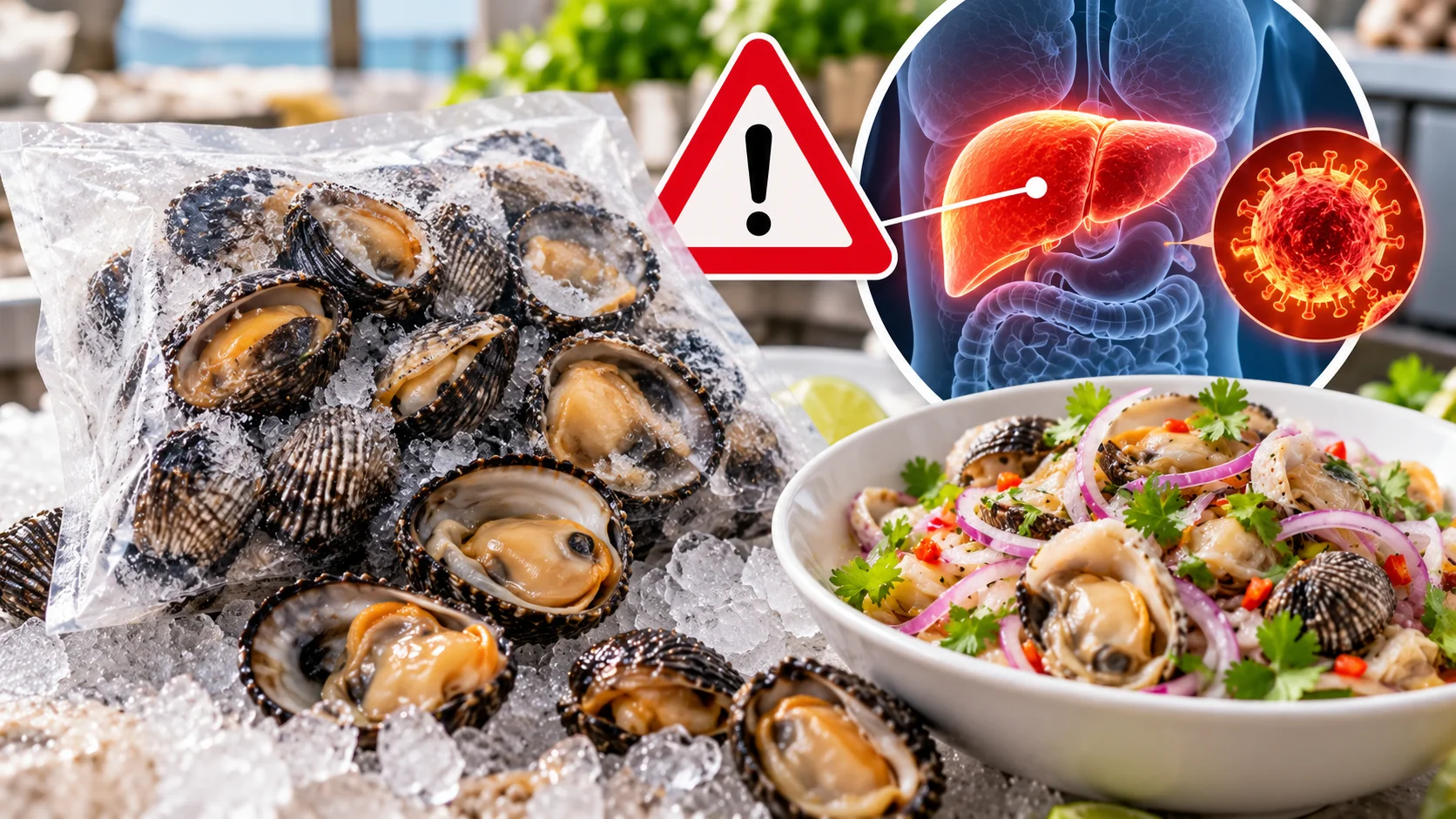
The recalled shell meat was imported from Ecuador and distributed in 16-ounce frozen packages to restaurants and retailers in several states, with possible further distribution. CDC says epidemiologic evidence indicates imported frozen clams may have been contaminated with hepatitis A virus, while traceback work continues to identify the source or sources of clams eaten raw or undercooked by people who became ill.
Quick Facts
- Product: La Serranita-brand frozen concha negra, or black shell clam meat
- Hazard: Potential contamination with hepatitis A virus
- Outbreak: 37 illnesses and 30 hospitalizations reported as of September 17, 2026
- Distribution: Restaurants and retailers in multiple states, with possible further distribution
Latest La Serranita Black Clams Recall and Outbreak Developments
September 2026
September 18, 2026 – CDC reported 37 outbreak-associated hepatitis A illnesses in four states. Illness onset dates ranged from July 30, 2025 through June 23, 2026, 30 of the 37 identified patients were hospitalized, and no deaths were reported.
[1]
September 18, 2026 – CDC reported that 77% of interviewed patients ate ceviche, 76% ate raw or undercooked shellfish, and 47% ate raw or undercooked conchas negras before becoming ill. The agency said the epidemiologic evidence suggests imported frozen clams may have been contaminated with hepatitis A virus, while traceback remains ongoing.
[1]
May 2026
May 22, 2026 – FDA expanded its warning concerning La Serranita-brand frozen concha negra shell meat from Ecuador. The agency reported distribution to restaurants and retailers in Connecticut, Massachusetts, New Jersey, New York, Ohio, and Pennsylvania, with possible further distribution.
[2]
FDA also reported that La Serranita products had been recalled by dealers in New York and New Jersey and that related hepatitis A illnesses had been reported in additional states.
[2]
April 2026
April 30, 2026 – FDA initially warned consumers, restaurants, and retailers not to eat, serve, or sell La Serranita-brand concha negra shell meat from Ecuador because it could be contaminated with hepatitis A virus. At that time, the product was known to have been distributed in New York and New Jersey, with possible further distribution.
[2]
What Is the La Serranita Black Clams Recall?
The recall involves La Serranita-brand concha negra, also described as black shell clam meat. FDA identifies the product as frozen shell meat imported from Ecuador and sold in 16-ounce plastic packages.
FDA has advised consumers not to eat the product and has told restaurants and retailers not to serve or sell it because of possible hepatitis A contamination.
Dealers in New York and New Jersey recalled La Serranita shell meat. FDA later expanded the known distribution area to Connecticut, Massachusetts, New Jersey, New York, Ohio, and Pennsylvania and cautioned that additional distribution may have occurred.
Why Were La Serranita Black Clams Recalled?
The shell meat was recalled because it may be contaminated with hepatitis A virus, or HAV. Hepatitis A can spread when a person eats food contaminated with the virus.
CDC says epidemiologic evidence from the outbreak indicates that imported frozen clams may have been contaminated and made people sick. Investigators continue working to determine the source or sources of frozen clams consumed by patients.
The investigation has focused particularly on raw or undercooked shellfish consumption, including conchas negras and ceviche.
How Many Hepatitis A Illnesses Have Been Reported?
As of September 17, 2026, CDC identified 37 illnesses associated with the outbreak in four states. Patients ranged from 6 to 40 years old, and illness onset dates ranged from July 30, 2025 through June 23, 2026.
Thirty of the 37 patients with available information were hospitalized, representing 81% of identified cases. CDC reported no deaths.
CDC also states that the actual number of illnesses may be higher because some people recover without seeking medical care or being tested, and recent illnesses may take time to be connected to an outbreak.
What Did Interviews With Patients Show?
Investigators asked patients about foods eaten during the 15 to 50 days before they became ill. CDC reported that 77% ate ceviche and 76% ate raw or undercooked shellfish.
Forty-seven percent reported eating raw or undercooked conchas negras. CDC said those percentages were significantly higher than comparable consumption levels found in the FoodNet Population Survey.
The agency concluded that the difference supports concern that raw or undercooked clams may have contributed to illnesses in the outbreak.
What Is Hepatitis A?
Hepatitis A is a liver infection caused by the hepatitis A virus. It is primarily spread through the fecal-oral route, including through contaminated food or water or close contact with an infected person.
[3]
Illness can range from mild symptoms lasting several weeks to more serious disease requiring hospitalization. Most people recover completely, but severe complications can occur in some patients.
Vaccination is the best way to prevent hepatitis A. Vaccination or other postexposure treatment may also be appropriate after certain recent exposures.
What Are the Symptoms of Hepatitis A?
CDC states that symptoms can include fatigue, fever, loss of appetite, nausea, vomiting, abdominal discomfort, joint pain, dark urine, light-colored stools, and yellowing of the skin or eyes known as jaundice.
[3]
Symptoms usually develop several weeks after exposure rather than immediately. FDA states that illness typically occurs within approximately 15 to 50 days after eating or drinking contaminated food or water.
Young children may have few or no symptoms, while adults are more likely to experience recognizable illness.
Why Can Hepatitis A Become Serious?
Most people eventually recover from hepatitis A, but the illness can last weeks or months and may lead to hospitalization. People with underlying liver disease and some other medical conditions can face a greater risk of severe complications.
The hospitalization rate in this outbreak has been particularly notable. CDC reports that 30 of the 37 identified patients with available information were hospitalized.
No deaths had been reported as of the agency’s September 2026 update.
Where Were the Recalled La Serranita Clams Distributed?
FDA reported that the shell meat was distributed to restaurants and retailers in Connecticut, Massachusetts, New Jersey, New York, Ohio, and Pennsylvania. The agency cautioned that further distribution may also have occurred.
Because restaurants received the product, some consumers may have eaten La Serranita shell meat without seeing the original package or knowing the brand name.
This distribution pattern can make restaurant receipts, credit-card statements, menu descriptions, and public-health interview records important in reconstructing a potential exposure.
Why Are Raw or Undercooked Clams a Concern?
CDC’s investigation found a strong pattern of raw or undercooked shellfish consumption among patients. More than three-quarters of interviewed patients reported eating raw or undercooked shellfish before becoming ill.
Nearly half specifically reported consuming raw or undercooked conchas negras. CDC also reported that 77% ate ceviche.
Ceviche is commonly prepared by marinating seafood in citrus juice, but that preparation should not be treated as equivalent to cooking for purposes of eliminating hepatitis A risk.
What Should Consumers Do With Recalled La Serranita Clams?
CDC recommends returning or throwing away frozen conchas negras affected by the recalls. FDA advises consumers not to eat the recalled product and tells restaurants and retailers not to serve or sell it.
FDA also recommends carefully cleaning and sanitizing surfaces and containers that came into contact with potentially contaminated shell meat. Food contaminated with hepatitis A virus may look, smell, and taste normal.
What Should Someone Do After Possible Exposure?
CDC advises people who ate frozen La Serranita-brand concha negra raw or undercooked within the previous 14 days and are not vaccinated against hepatitis A to contact a healthcare provider or local health department.
[1]
A healthcare professional can determine whether postexposure prophylaxis may be appropriate. People who develop hepatitis A symptoms after possible exposure should also seek medical advice.
Because symptoms can develop weeks later, consumers should tell their healthcare provider about the shellfish exposure when discussing possible hepatitis A symptoms.
Who May Be Affected?
Consumers who ate La Serranita-brand frozen concha negra may have been exposed, particularly when the shellfish was served raw or undercooked. Restaurant diners may not know the brand or distributor of the clams they consumed.
People who were later diagnosed with hepatitis A may want to preserve restaurant receipts, purchase records, photographs, medical records, laboratory reports, and information about when and where the shellfish was eaten.
What Evidence May Matter in a La Serranita Black Clams Claim?
Foodborne-illness claims can depend on establishing both exposure to the implicated food and a medically supported connection to the illness.
- The original La Serranita package or remaining product
- Restaurant receipts or credit-card records
- Retail purchase records
- Photographs of packaging or menu items
- Medical records documenting hepatitis A
- Laboratory test results
- Information showing when and where the clams were eaten
The relatively long hepatitis A incubation period can make accurate timing especially important when investigators evaluate possible exposure.
Who May Be Liable for a Hepatitis A Foodborne Illness?
Potential liability depends on the facts and applicable law. Importers, processors, distributors, restaurants, retailers, or other businesses in a food product’s supply chain may potentially be evaluated when contaminated food allegedly causes illness.
Product-liability law can impose responsibility on certain parties involved in manufacturing or selling a defective product, depending on the jurisdiction and facts of the case. Negligence, warranty, and other state-law theories may also be relevant.
[4]
A recall, outbreak investigation, or diagnosis does not by itself establish civil liability against a particular business. Exposure, causation, damages, and the applicable legal standard still must be evaluated.
Current La Serranita Black Clams Lawsuit and Recall Status
The principal documented public-health actions are the FDA safety alert, dealer recalls in New York and New Jersey, and CDC’s continuing multistate hepatitis A outbreak investigation. CDC states that traceback work remains ongoing.
The CDC and FDA materials cited here do not announce a nationwide class-action settlement, multidistrict litigation proceeding, or coordinated compensation program involving La Serranita concha negra.
Individual foodborne-illness claims may still warrant legal review when a consumer develops medically documented hepatitis A after eating recalled or outbreak-associated shellfish.
Do I Qualify for a La Serranita Black Clams Claim?
- Did you eat La Serranita-brand concha negra or black clam meat?
- Did you eat raw or undercooked black clams or ceviche containing shellfish?
- Were you later diagnosed with hepatitis A or hospitalized for related symptoms?
- Can you document the restaurant, purchase, medical care, or laboratory testing involved?
Answering yes to one or more questions does not automatically establish a lawsuit. An attorney can review the exposure history, restaurant or purchase records, laboratory results, medical documentation, and applicable filing deadlines to determine whether further investigation may be appropriate.
Legal Process for a La Serranita Black Clams Claim
- Free case review. An attorney reviews the shellfish exposure, diagnosis, medical treatment, and available documentation.
- Investigation. Evidence may include receipts, packaging, restaurant information, laboratory results, medical records, and CDC or FDA outbreak information.
- Filing. If the evidence and applicable law support a claim, a foodborne-illness lawsuit may be filed against one or more potentially responsible parties.
- Discovery/negotiation. The parties may exchange records, obtain testimony, consult medical or food-safety experts, and discuss possible resolution.
- Resolution. A case may conclude through settlement, dismissal, court ruling, or trial depending on its facts and procedural history.
Compensation in a Hepatitis A Foodborne Illness Case
Depending on the circumstances, a claim may seek damages for hospitalization, medical expenses, lost income, pain and suffering, follow-up care, and other losses permitted under applicable law.
Compensation amounts vary by case. Past results do not guarantee future outcomes.
Important La Serranita Black Clams Recall Developments
| Event |
Month/Year |
Type |
Status |
Source |
Notes |
| CDC Outbreak Update |
September 2026 |
Outbreak Investigation |
Ongoing |
[1] |
37 illnesses, 30 hospitalizations |
| Expanded FDA Distribution Warning |
May 2026 |
Food Safety Alert |
Active |
[2] |
Six states identified |
| Initial FDA Warning |
April 2026 |
Food Safety Alert |
Issued |
[2] |
Do not eat product |
Frequently Asked Questions
What is the La Serranita Black Clams Lawsuit?
The La Serranita Black Clams Lawsuit topic concerns potential individual claims involving frozen concha negra shell meat recalled because of possible hepatitis A contamination. CDC is investigating a multistate outbreak potentially linked to imported frozen clams.
Which La Serranita black clams were recalled?
The affected product is La Serranita-brand concha negra, or black shell clam meat, imported from Ecuador and sold frozen in 16-ounce plastic packages.
How many hepatitis A illnesses have been reported?
As of September 17, 2026, CDC reported 37 outbreak-associated illnesses in four states. Thirty patients were hospitalized, and no deaths were reported.
Where were the recalled black clams distributed?
FDA reported distribution to restaurants and retailers in Connecticut, Massachusetts, New Jersey, New York, Ohio, and Pennsylvania, with possible further distribution.
What symptoms can hepatitis A cause?
Symptoms may include fatigue, fever, nausea, vomiting, abdominal discomfort, joint pain, dark urine, light-colored stools, loss of appetite, and jaundice.
How long after exposure can hepatitis A symptoms appear?
FDA says illness usually occurs within approximately 15 to 50 days after eating or drinking contaminated food or water.
What should I do if I ate recalled La Serranita clams?
If you ate recalled clams raw or undercooked within the previous 14 days and are not vaccinated against hepatitis A, CDC recommends contacting a healthcare provider or local health department to discuss postexposure treatment.
Can I file a La Serranita Black Clams Lawsuit?
A person diagnosed with hepatitis A after eating recalled or outbreak-associated black clams may warrant individual legal review. A recall or outbreak investigation does not itself establish liability, and any claim depends on exposure evidence, medical diagnosis, causation, damages, and applicable law.
Do I Have a La Serranita Black Clams Lawsuit?
If you or a loved one developed hepatitis A after eating recalled La Serranita concha negra or other outbreak-associated frozen clams, you may have legal options. Contact Schmidt & Clark for a free case review.
Start My Free Case Review
References
[1] https://www.cdc.gov/hepatitis-a/outbreaks/clams-2026/index.html
[2] https://www.fda.gov/food/alerts-advisories-safety-information/safety-alert-hepatitis-virus-concha-negra-black-shell-shell-meat-april-2026
[3] https://www.cdc.gov/hepatitis-a/about/index.html
[4] https://www.law.cornell.edu/wex/products_liability