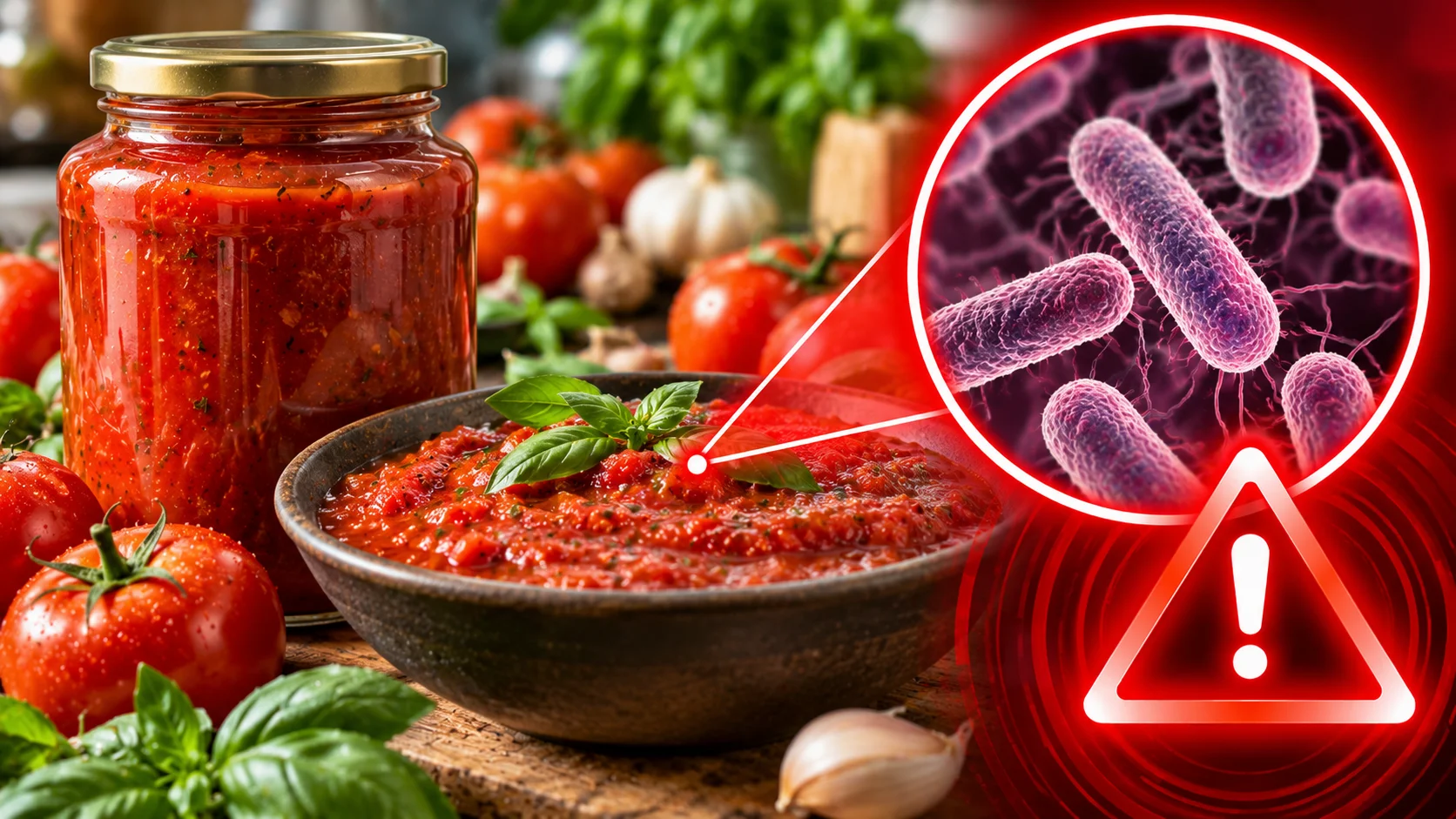
Recent examples include a 2025 recall of First & Last tomato sauces because they were manufactured without an approved scheduled process and a 2026 recall of a commercially canned tomato-based salsa over similar processing concerns. Historical surveillance also documents confirmed botulism outbreaks associated with home-canned tomato sauce and home-prepared spaghetti sauce. Botulism is a medical emergency, and anyone experiencing difficulty swallowing, double vision, muscle weakness, slurred speech, or difficulty breathing after eating a suspect sauce should seek immediate medical attention.
Quick Facts
- Hazard: Botulinum neurotoxin produced by Clostridium botulinum under favorable conditions
- Primary concern: Improperly canned, acidified, preserved, or stored tomato-based sauces
- Symptoms: Double vision, difficulty swallowing, muscle weakness, paralysis, and breathing problems
- Documented events: Commercial recalls and confirmed outbreaks have involved tomato-based sauces and home-canned tomatoes
Latest Tomato Sauce Botulism Developments
March 2026
March 11, 2026 – Marvel Food and Deli recalled Country Style Adjika, a commercially canned tomato-based salsa, because inspectors found it had been canned using an unapproved process that could allow growth of the microorganism responsible for botulism. The 32-ounce jars were produced between January 2024 and March 2026, and no illnesses had been reported when the recall was announced.
[1]
November 2025
November 3, 2025 – FDA posted a recall involving First & Last Original Marinara Sauce Tomato & Basil, Traditional Pasta Sauce Meat Flavored, and Puttanesca Sauce because the products had been manufactured without an approved scheduled process or adequate evaluation of the processing method. FDA warned that improperly processed acidified or low-acid canned foods can permit Clostridium botulinum toxin formation.
[2]
November 3, 2025 – The First & Last sauces were sold in 26-fluid-ounce jars in Connecticut and Massachusetts, including through Big Y and potentially other retailers. No illnesses had been reported when the recall was announced.
[2]
What Is Foodborne Botulism?
Foodborne botulism is a rare but severe neurological illness caused by eating food containing botulinum neurotoxin. The toxin attacks the body’s nerves and can cause progressive muscle weakness, paralysis, respiratory failure, and death.
Clostridium botulinum spores are widespread in the environment and usually do not cause illness simply because they are swallowed. The danger develops when spores are placed in conditions that allow them to grow and produce toxin.
How Can Tomato Sauce Become Contaminated With Botulism?
Clostridium botulinum can produce toxin when food provides a low-oxygen environment combined with favorable acidity, moisture, salt, sugar, and temperature conditions. A sealed jar or can can create the oxygen-free environment needed for toxin production if other safety controls are inadequate.
CDC explains that some tomatoes can fall into the low-acid category and that low-acid home-canned foods require special precautions. Improper acidification, inadequate pressure or heat processing, contamination after processing, damaged containers, or unsafe storage can increase the risk.
[3]
Why Does Acidity Matter in Tomato Sauce?
Acidity is one of the primary barriers that prevents Clostridium botulinum from growing. Foods with a pH above 4.6 are considered low-acid and require processing methods capable of controlling botulinum spores.
Tomatoes are often thought of as naturally acidic, but their acidity varies. Tomato sauces may also contain onions, peppers, meat, garlic, herbs, or other ingredients that can raise the overall pH and change the processing requirements.
Can Commercial Tomato Sauce Cause Botulism?
Commercial botulism involving tomato sauce is uncommon because regulated manufacturers generally use validated thermal-processing and acidification procedures. Commercial products can still be recalled when regulators discover that required processing safeguards were not properly validated or followed.
The 2025 First & Last recall illustrates this risk. FDA did not report that botulinum toxin had been detected in the sauces; instead, the products were recalled because the manufacturing process had not been adequately approved or evaluated to ensure protection against toxin formation.
First & Last Tomato Sauce Botulism Recall
First and Last Bakery LLC of Hartford, Connecticut, recalled three tomato-based sauces in 2025 because of a potential Clostridium botulinum hazard.
- First & Last Original Marinara Sauce, Tomato & Basil
- First & Last Original Traditional Pasta Sauce, Meat Flavored
- First & Last Original Puttanesca Sauce, Mildly Hot & Spicy
The sauces were packaged in 26-fluid-ounce jars with September 2026 use-by dates and distributed beginning September 22, 2025. FDA stated that failure to appropriately process acidified or low-acid canned foods can allow botulinum toxin to form.
[2]
2026 Country Style Adjika Recall
In March 2026, Marvel Food and Deli recalled Country Style Adjika, described as a tomato-based salsa, because an inspection found that it had been canned using an unapproved process.
The company said the processing issue could allow growth of the organism that causes botulism. The recall involved 32-ounce jars with SKU 72176232104 produced from January 2024 through March 2026, and no illnesses were reported at announcement.
[1]
Confirmed Botulism Outbreaks Involving Tomato Sauce
Unlike recalls based only on a potential processing hazard, public-health surveillance has documented confirmed botulism cases associated with tomato sauces and other tomato-containing foods.
CDC’s 2014 Botulism Annual Summary documented a laboratory-confirmed outbreak involving home-canned tomato sauce that caused two cases of foodborne botulism.
[4]
Canadian surveillance also recorded a 2006 outbreak involving home-prepared spaghetti sauce that caused two cases of type A botulism. The event provides another documented example of botulism associated with tomato-based sauce prepared outside commercial processing controls.
[5]
Why Home-Canned Tomato Sauce Can Be Especially Risky
Home canning does not have the same automated process controls used by commercial canners. Errors involving acidity, pressure, temperature, processing time, recipe modification, jar size, or storage can create conditions favorable to toxin production.
CDC advises using tested canning instructions and warns that some tomatoes must be treated as low-acid foods. Home-canned tomatoes and foods containing them require particular attention to approved acidification and processing methods.
[3]
Can You Tell if Tomato Sauce Contains Botulinum Toxin?
Not reliably. Food contaminated with botulinum toxin may not necessarily look, smell, or taste spoiled.
Bulging, leaking, damaged, or swollen containers and jars that spurt liquid or foam when opened are warning signs that food should be discarded. The absence of visible spoilage does not establish that a product is safe.
What Are the Symptoms of Foodborne Botulism?
Botulism attacks the nervous system and commonly causes difficulty swallowing, muscle weakness, double or blurred vision, drooping eyelids, slurred speech, difficulty moving the eyes, and difficulty breathing.
Foodborne botulism can also cause nausea, vomiting, abdominal pain, or diarrhea. CDC considers botulism a medical emergency because paralysis can progress to the muscles responsible for breathing.
[6]
How Quickly Can Botulism Symptoms Appear?
Foodborne botulism symptoms often begin within hours to several days after contaminated food is eaten, although the timing can vary considerably.
Anyone developing neurological symptoms after eating recalled, improperly canned, or suspect tomato sauce should seek emergency medical evaluation rather than waiting for symptoms to resolve.
Who May Be Affected?
Anyone who consumes food containing botulinum toxin can develop foodborne botulism. Severe botulism is not limited primarily to older adults or people with weakened immune systems.
Consumers who become ill after eating recalled commercial sauce or improperly preserved homemade tomato sauce should preserve any remaining container, product label, purchase information, medical records, laboratory results, and information concerning when the food was eaten.
What Evidence May Matter in a Tomato Sauce Botulism Claim?
- The tomato sauce container and label
- Lot, batch, use-by, or production information
- Purchase receipts or retail records
- Remaining food, if retained safely by public-health authorities
- Medical records documenting neurological symptoms
- Laboratory confirmation of botulinum toxin or Clostridium botulinum
- Public-health investigation records
- Hospitalization and treatment records
Botulism claims can require detailed evidence linking an illness to a particular food product or production process.
Who May Be Liable for Tomato Sauce Botulism?
Potential liability depends on the facts and applicable law. Manufacturers, processors, canners, ingredient suppliers, distributors, retailers, restaurants, or other businesses may potentially be evaluated when commercially sold contaminated food causes an injury.
A recall or processing violation does not automatically establish civil liability. A claimant generally must establish product identification, exposure, causation, injury, and legally recoverable damages.
Current Tomato Sauce Botulism Lawsuit and Recall Status
The most recent documented tomato-based commercial action identified here is the March 2026 Country Style Adjika recall, while the November 2025 First & Last action involved marinara, traditional pasta sauce, and puttanesca sauce.
The cited recall materials do not themselves announce a nationwide tomato sauce botulism class action, multidistrict litigation proceeding, or coordinated settlement. Individual claims may still be evaluated when medical and product evidence connects botulism with a particular commercially sold sauce.
Do I Qualify for a Tomato Sauce Botulism Claim?
- Did you eat tomato sauce, pasta sauce, salsa, or another tomato-based product later implicated in a botulism recall or investigation?
- Did you develop neurological symptoms consistent with foodborne botulism?
- Were you hospitalized, treated with botulism antitoxin, or diagnosed with botulism?
- Can you identify the product, exposure date, manufacturer, batch, or other evidence connecting your illness to the sauce?
Answering yes to one or more questions does not automatically establish a lawsuit. An attorney can review the product evidence, medical diagnosis, public-health findings, damages, and applicable filing deadlines.
Legal Process for a Tomato Sauce Botulism Claim
- Free case review. An attorney reviews the food exposure, diagnosis, medical treatment, and available product information.
- Investigation. Evidence may include packaging, recall records, laboratory findings, medical records, purchase records, and public-health investigation materials.
- Filing. If the evidence and applicable law support a claim, a foodborne-illness lawsuit may be filed against one or more potentially responsible parties.
- Discovery/negotiation. The parties may exchange records, obtain testimony, consult medical and food-safety experts, and discuss possible resolution.
- Resolution. A case may conclude through settlement, dismissal, court ruling, or trial depending on its facts.
Compensation in a Botulism Foodborne Illness Case
Depending on the circumstances, recoverable damages may include hospitalization, intensive care, ventilator treatment, rehabilitation, lost income, pain and suffering, permanent neurological impairment, future healthcare expenses, or wrongful-death damages.
Compensation amounts vary by case. Past results do not guarantee future outcomes.
Important Tomato Sauce Botulism Events
| Event |
Month/Year |
Type |
Status |
Source |
Notes |
| Country Style Adjika Recall |
March 2026 |
Commercial Recall |
Announced |
[1] |
Unapproved canning process |
| First & Last Sauce Recall |
November 2025 |
Commercial Recall |
Announced |
[2] |
Potential botulism hazard |
| Home-Canned Tomato Sauce Outbreak |
2014 |
Confirmed Outbreak |
Closed |
[4] |
Two laboratory-confirmed cases |
| Spaghetti Sauce Outbreak |
2006 |
Confirmed Outbreak |
Closed |
[5] |
Two type A cases |
Frequently Asked Questions
What is a Tomato Sauce Botulism Lawsuit?
A Tomato Sauce Botulism Lawsuit may involve a foodborne-illness claim alleging that commercially sold tomato sauce contained botulinum toxin or was processed under unsafe conditions that led to botulism. A viable claim generally requires evidence linking the product to the person’s diagnosed illness.
Can botulism grow in tomato sauce?
Yes, under certain conditions. If a tomato sauce is insufficiently acidic and is improperly canned, processed, or stored in a low-oxygen container, Clostridium botulinum spores may be able to grow and produce toxin.
Has botulism actually been linked to tomato sauce?
Yes. CDC surveillance documented two laboratory-confirmed foodborne botulism cases associated with home-canned tomato sauce in 2014, and Canadian surveillance recorded two cases associated with home-prepared spaghetti sauce in 2006.
Was botulinum toxin found in the First & Last tomato sauces?
The FDA recall notice did not report detecting botulinum toxin in the recalled sauces. The products were recalled because they had been manufactured without an adequately approved or evaluated process capable of assuring protection against toxin formation.
Can you smell or taste botulinum toxin?
Consumers should not rely on smell, taste, or appearance to determine whether food contains botulinum toxin. Suspect or recalled food should not be tasted to determine whether it is safe.
What should I do if I ate recalled tomato sauce?
Follow the recall instructions and do not consume additional product. If neurological symptoms such as double vision, difficulty swallowing, muscle weakness, or breathing difficulty develop, seek emergency medical care immediately.
How serious is foodborne botulism?
Botulism can progress to paralysis and respiratory failure and can be fatal without prompt treatment. CDC considers suspected botulism a medical emergency.
Can I file a Tomato Sauce Botulism Lawsuit?
A person diagnosed with botulism after eating a commercially sold tomato sauce implicated by product, laboratory, or public-health evidence may warrant individual legal review. The existence of a recall alone does not prove causation or liability.
Do I Have a Tomato Sauce Botulism Lawsuit?
If you or a loved one developed botulism after eating contaminated tomato sauce or another recalled tomato-based product, you may have legal options. Contact Schmidt & Clark for a free case review.
Start My Free Case Review
References
[1] https://marvelfoodanddeli.com/2026/03/11/marvel-food-and-deli-recalls-canned-country-style-adjika-tomato-based-salsa-due-to-botulism-risk/
[2] https://www.fda.gov/safety/recalls-market-withdrawals-safety-alerts/first-and-last-bakery-llc-recalls-first-and-last-brand-tomato-sauce-products-because-possible-health
[3] https://www.cdc.gov/botulism/prevention/home-canned-foods.html
[4] https://stacks.cdc.gov/view/cdc/46260
[5] https://wwwnc.cdc.gov/eid/syn/en/article/29/9/23-0409.htm
[6] https://www.cdc.gov/botulism/signs-symptoms/index.html